Best aurora forecast app in 2026: an honest comparison
My Aurora Forecast, Hello Aurora, Aurora Now, SpaceWeatherLive, Norya. Which aurora forecast app actually answers the only question that matters tonight.

Search for the best aurora forecast app and you get the same list everywhere: My Aurora Forecast on top, a few others behind it, and almost never a word about what actually separates them.
This comparison works the other way round. It starts from the question you ask at two in the morning, standing in the cold: is it worth staying out? Apps are ranked by what they do with that question, not by how many charts they can draw.
We make one of them, Norya. So further down you will also find the list of everything it does worse than the others. A comparison where the author wins on every line is useless to you.
Showing a Kp index is not forecasting an aurora
This is the confusion the whole category is built on.
Kp measures how disturbed Earth’s magnetic field is, across the entire planet, in three-hour blocks. It is an excellent scientific measurement. It is not an observation forecast: it knows nothing about your latitude, nothing about the overcast above your head, nothing about the Moon that is about to rise.
Seeing an aurora needs five conditions at once:
- Auroral activity overhead, not merely somewhere on the globe.
- A clear sky, which is the number one reason people see nothing.
- Real darkness, meaning the Sun far enough below the horizon.
- Little Moon, or a low one. A high full Moon erases a weak display.
- Solar wind pointing the right way, in particular a southward Bz.
An app that shows you the first and leaves you to find the other four has saved you five minutes out of the thirty the job takes. The table below ranks apps by how many of those five they fold into a single verdict.
The table
Taken from the US App Store on 16 September 2026. Ratings move and features change: this is a snapshot, not a permanent truth.
| App | App Store ratings | iOS | iPad | Free alerts | Clouds inside the verdict |
|---|---|---|---|---|---|
| My Aurora Forecast | 69,383 (4.7) | 17.0 | yes | yes | no, shown alongside |
| Aurora Forecast. (TINAC) | 4,831 (4.6) | 18.6 | yes | no | yes, through its AI analyst |
| Aurora Now | 1,566 (4.7) | 16.6 | yes | no | no |
| AuroraWatch UK | 352 (4.8) | 13.0 | yes | yes, UK only | no |
| SpaceWeatherLive | 190 (4.0) | 13.0 | yes | no | no |
| Hello Aurora | 109 (4.4) | 16.4 | yes | no | partly |
| PULSAR | none yet | 15.0 | no | no | yes, crossed with a dark-sky map |
| Norya | none yet | 18.0 | no | no | yes, at the core of the score |
Two columns need explaining.
Free alerts marks the apps that will wake you without a payment. It is rare, and it is My Aurora Forecast’s strongest argument.
Clouds inside the verdict separates apps that display the weather next to the Kp from apps that put it inside the number they show you. In practice the difference is enormous: a Kp of 6 under solid stratus produces nothing, and an app that still announces “high activity” sends you outside for no reason.
The apps, one by one
My Aurora Forecast, the installed default
By a wide margin the most downloaded: 69,383 ratings on the US App Store alone, averaging 4.7. Twelve languages, iPhone and iPad, and a separate paid Pro version at $3.99.
Its listing promises the current Kp, a list of the best viewing locations right now, a world map based on NOAA’s OVATION model, high-resolution solar imagery, and forecasts for the next hour, the next several hours and the next several weeks.
Its real strength is that push notifications are free. No other app in this comparison does that.
Its limit is that it gives you indicators rather than a decision. Weather sits beside the numbers instead of inside them. It is a dashboard, a very good one, but a dashboard.
Aurora Forecast. by TINAC, the closest rival
This is the one worth studying, because it aims where Norya aims. Its listing describes an “AI Aurora Analyst” running on Apple Intelligence that produces a Go / No-Go verdict from your exact location and local weather. It adds live sightings from its community, plotted on the map.
4,831 ratings at 4.6, and roughly thirty languages. It requires iOS 18.6, the newest requirement in this comparison.
Where it beats Norya: community sightings. Knowing that somebody twenty-five miles away can see it right now beats any model, and Norya has nothing equivalent.
Where it is debatable: a verdict produced by a language model is hard to audit. You cannot tell exactly what tipped it, or what it does when a source goes missing.
Hello Aurora, community first
Hello Aurora’s listing claims more than 108,000 sightings reported since 2020 by over 327,000 users. That is its real asset: today’s peak viewing hours are inferred from what people report, not only from a model.
It shows Bz and storm activity, and keeps the 27-day guide and the peak hours for its Pro tier.
Its US rating count stays modest, 109 at 4.4, which makes sense: its audience is largely Icelandic and Nordic.
Aurora Now, the fine-grained alerts
1,566 ratings at 4.7, thirteen languages, iPhone and iPad. Its listing leans hard on how finely its alerts can be tuned, claiming more customisation than any other aurora app on the store. Location-based local forecast, with custom locations supported.
SpaceWeatherLive, for people who read curves
190 ratings at 4.0, the lowest average here, and that is not a criticism. This app is not trying to charm anyone. It serves raw space weather, the same data as the website of the same name, which enthusiasts have used for years.
If you know what Bt is and why a Bz at −15 nT matters, you will like it. If you do not, it will not teach you how to decide.
AuroraWatch UK, the special case
352 ratings at 4.8, the best average in this comparison. It is built on magnetometers run by Lancaster University and alerts for free, but only for the United Kingdom. Outside the British Isles it has no purpose.
PULSAR, the French newcomer
Worth knowing about even outside France. Its listing advertises a forecast up to six days out built on NOAA data, real-time alerts with adjustable Kp thresholds delivered through unusual channels (push, email, Discord or Slack webhooks), and a light pollution map on the Bortle scale crossed with live weather that suggests the five darkest spots near you.
That dark-sky spot map is a genuine feature Norya does not have. French and English, iPhone only, no ratings yet.
Norya, one number for your sky
Here is what ours does, and why we wrote it into an already crowded category.
Norya computes a score from 0 to 100 that contains all five factors at once: auroral activity from NOAA’s OVATION model 30 to 90 minutes out, three cloud layers with visibility and rain, darkness computed from the real solar elevation, the Moon’s phase and height, and solar wind averaged over thirty minutes. The number is for your position and the hour ahead, not for the planet and not for the next three hours.
It is always written “79 /100”, never “79 %”. It is not a probability, and the app’s design rules forbid implying that it is.
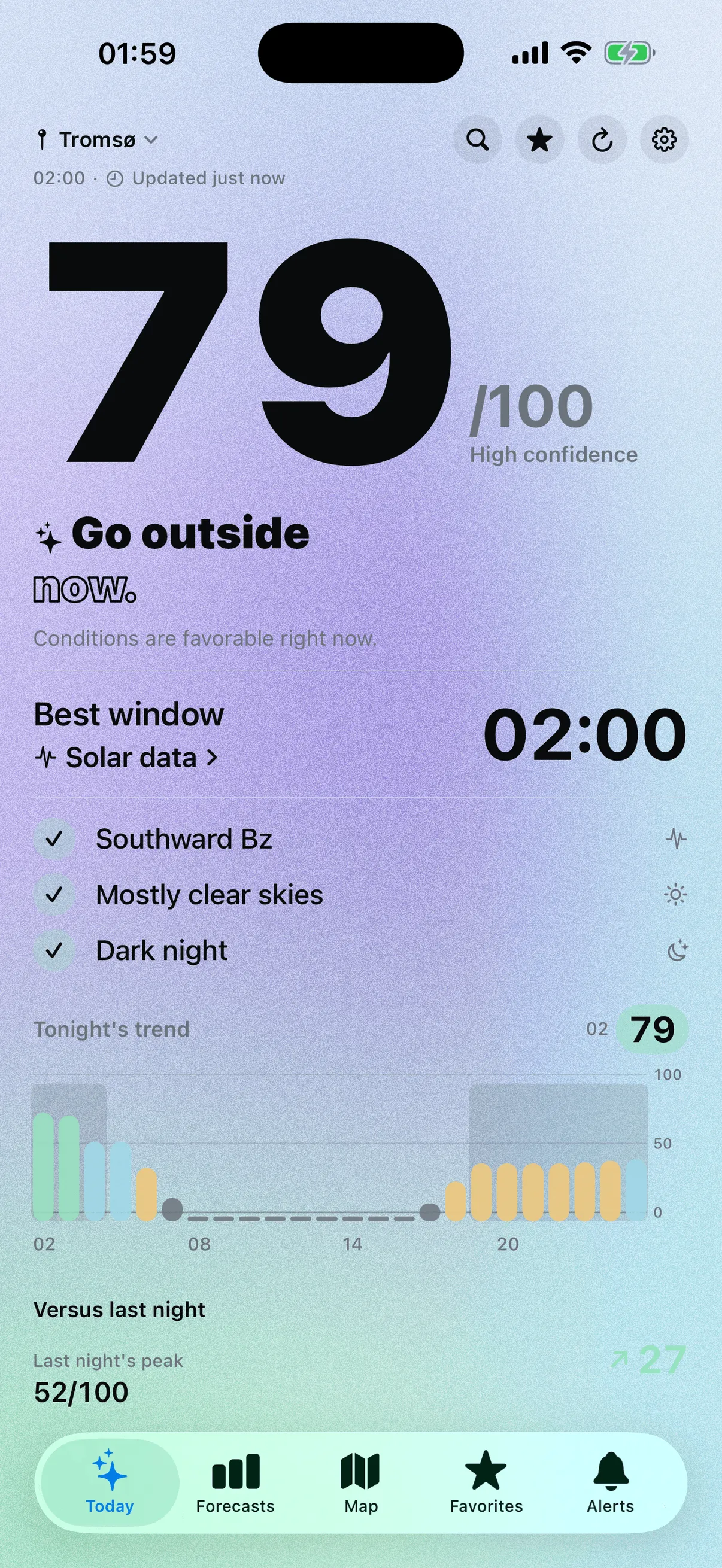
Score, verdict, window. One number instead of five gauges.
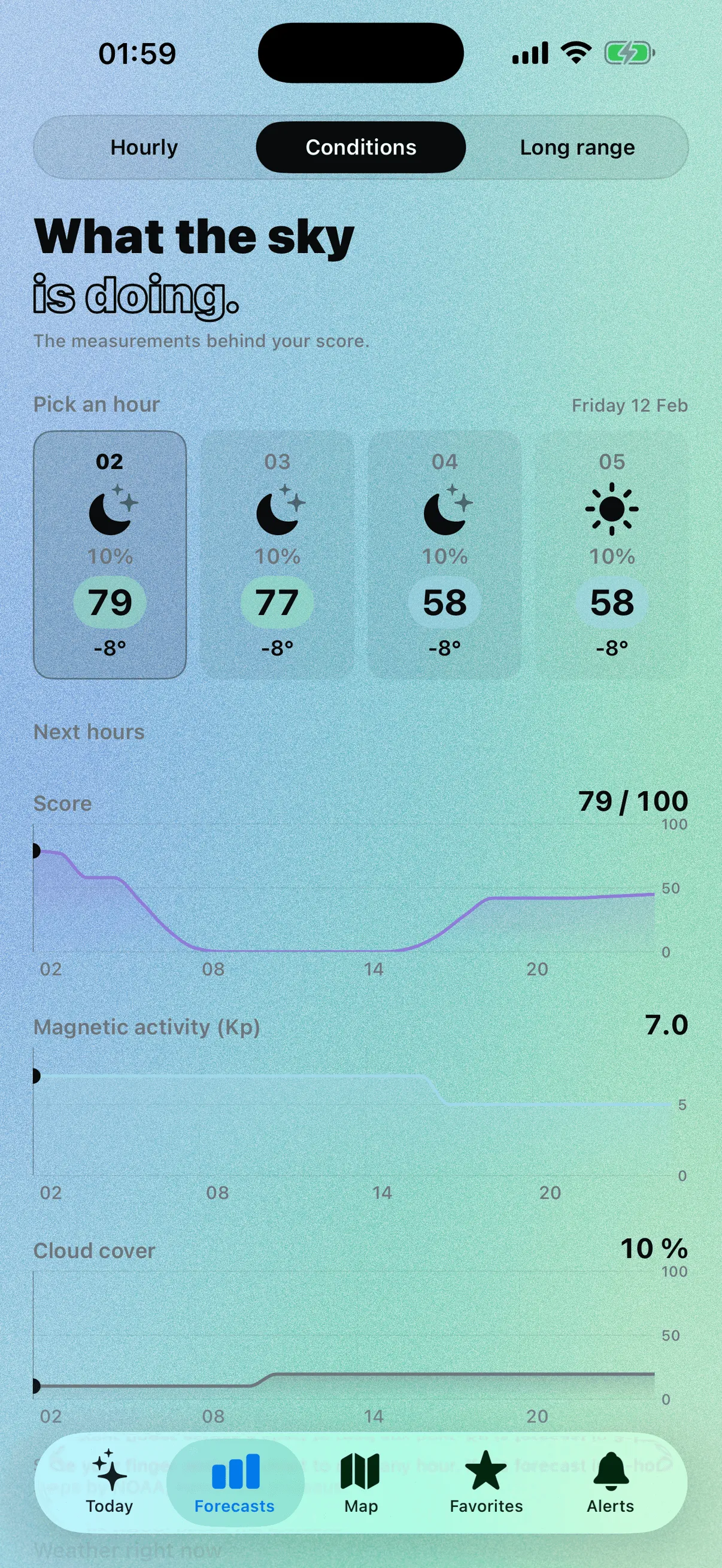
The measurements stay available underneath, for anyone who wants to check.
The part we think matters most is the part nobody advertises: what the app refuses to do.
- No weather, no score. Not zero, not a neutral value. A zero means “no chance”, which is not the same thing as “I do not have the data”.
- A fully overcast sky gives zero, with no floor quietly letting 60 % of the score through under solid stratus.
- Two sources are never maximised together. When OVATION and the Kp fallback disagree, confidence drops rather than the score rising.
- Times belong to the place you are looking at. Checking Tromsø from Chicago shows Tromsø time.
One more point, technical but season-changing. Most apps require astronomical night, meaning the Sun 18 degrees below the horizon. Sky brightness measurements do not support that line: between −18° and −12° the background changes by a factor of 7, while between −12° and −6° it changes by a factor of 400. Norya therefore sets its threshold near −10°, which opens the Tromsø season in late August instead of 20 September.
What Norya does worse
The list is real, and you should read it before downloading.
- iPhone only, iOS 18 and later. No iPad, no Mac, no Android. Seven of the eight apps compared here also run on iPad.
- No App Store ratings. Norya shipped on 2 September 2026. Against 69,383 reviews for My Aurora Forecast that is a genuine disadvantage, and we will not paper over it with invented testimonials.
- No community sightings. Hello Aurora and Aurora Forecast have them, and no model replaces a person telling you it is happening now.
- No dark-sky spot map. PULSAR has one on the Bortle scale. Norya shows NASA VIIRS night imagery on its map, which is not the same as a ranked list of spots.
- Alerts are paid. My Aurora Forecast and AuroraWatch UK notify you for free. In Norya, alerts belong to Norya Pro, from €2.99 for fifteen days.
- Two languages only, English and French, against twelve for My Aurora Forecast.
- No photography guidance. Several rivals explain camera settings for shooting an aurora. Norya stays out of that.
Which one to choose
You are flying to Tromsø, Iceland or Fairbanks for a week
You need to be woken while you sleep, and a fast read in the morning. Take My Aurora Forecast for the free alerts, and Norya to decide each evening: its fifteen-day pass at €2.99 covers exactly the length of a trip and stops by itself, with nothing to cancel.
You are watching from the northern United States, Canada or the UK
Your problem is not activity, it is frequency: a handful of nights a year. What you need is a reliable alert with a high threshold and a cloud filter, or you will go outside ten times for nothing.
AuroraWatch UK is excellent if you are in Britain and want free alerts. Norya helps through its confidence requirement, which stops an unstable forecast from waking you.
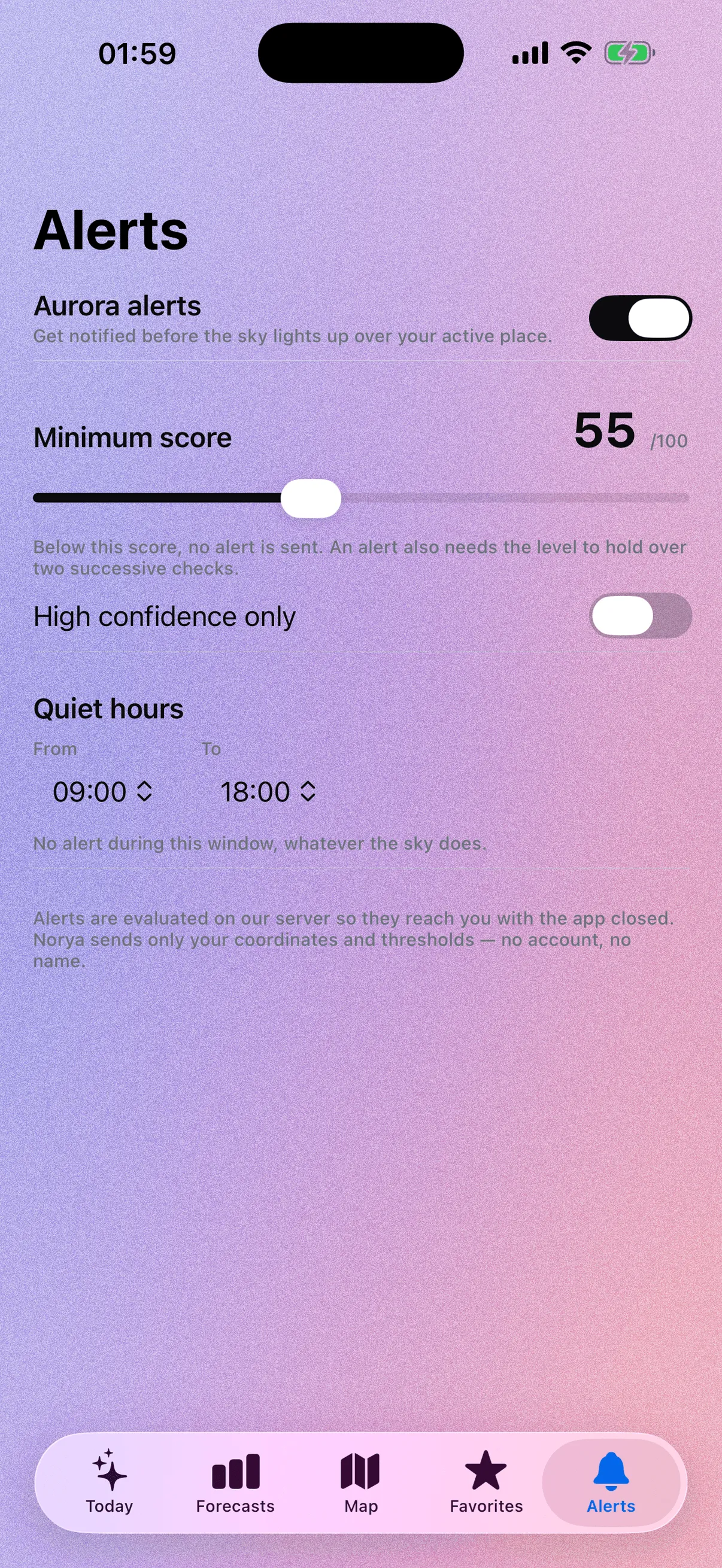
Threshold, required confidence and quiet hours are three separate settings.
You want to understand space weather
SpaceWeatherLive, without hesitation, alongside the NOAA SWPC website. No consumer app replaces reading the curves directly.
You are on Android
Norya does not exist on Android and is not planned for it. My Aurora Forecast and Aurora Now both ship there.
The websites still matter
An app does not replace a source. Three pages are worth a bookmark:
- The NOAA Space Weather Prediction Center, which publishes the 30 to 90 minute OVATION model that nearly every app here derives from.
- SpaceWeatherLive, which presents the same data far more readably.
- Aurora Map, a free web app covering both hemispheres.
None of them knows the weather above your garden or how high the Moon is where you stand. That is precisely the job a local app should be doing for you.