Where to see the northern lights: 20 places ranked by your real odds
Most lists rank destinations by latitude on a map. The measure that decides is geomagnetic latitude: 20 places ranked, with the Kp each needs and its real season.
Where to see the northern lights: every list gives you the same names, Tromsø, Rovaniemi, Fairbanks, and they are not wrong. They are wrong about the order, because they rank destinations by their latitude on a map.
The aurora does not care about that map. It sits in a ring centered on the geomagnetic pole, which is over Arctic Canada, about nine degrees away from the geographic pole. So two towns at the same latitude can have wildly different odds, and several celebrated destinations turn out to need a storm.
This page ranks 20 places by their real distance to the auroral oval, gives the Kp each one needs, and says when its season actually opens.
The map lies, and Churchill proves it
Three towns, three latitudes, and a ranking that inverts the moment you use the right measure.
| Place | Latitude on a map | Geomagnetic latitude |
|---|---|---|
| Tromsø, Norway | 69.7° | 67.5° |
| Churchill, Manitoba | 58.8° | 67.2° |
| Reykjavik, Iceland | 64.2° | 68.9° |
Churchill sits 11 degrees further south than Tromsø on a map, about 750 miles, and is within a third of a degree of it in the only measure that counts. Reykjavik, five degrees south of Tromsø, is actually closer to the oval than either.
The auroral oval is the only map that matters
The aurora does not switch on when a storm hits. It is there permanently, as a glowing ring centered on the geomagnetic pole, called the auroral oval. The only question that concerns you is whether you are underneath it.
NOAA’s Space Weather Prediction Center gives the rule: when the Sun is quiet, the lower edge of that ring sits near 66 degrees of geomagnetic latitude, and it descends about two degrees per Kp step as activity rises.
That gives you the useful question when choosing a destination: how far are you from 66? If you are already past it, the aurora passes overhead on any clear night, and weather becomes your only variable. If you are short of it, you are waiting for the oval to come down to you, and you will see it as a glow low on the northern horizon.
Why North America starts ahead
The geomagnetic pole sits near 80.7° north, 72.7° west, over the Canadian Arctic. That nine-degree tilt drags the whole ring toward North America.
The North American sector gains enormously: Churchill picks up 8.4 degrees between its map latitude and its geomagnetic one, Yellowknife more than six, Iceland close to five. Scandinavia loses two. Continental Europe pays the full price, which is why Paris, further north than Quebec City on a map, is six degrees worse off in the measure that matters.
The ranking: 20 places, the Kp each needs, and its season
| Place | Map latitude | Geomagnetic | Kp to get it overhead | Useful season |
|---|---|---|---|---|
| Utqiagvik, Alaska | 71.3° | 70.1° | Kp 0 | Sep 1 to Apr 12 |
| Akureyri, Iceland | 65.7° | 69.7° | Kp 0 | Aug 15 to Apr 29 |
| Reykjavik, Iceland | 64.2° | 68.9° | Kp 0 | Aug 10 to May 4 |
| Yellowknife, NWT | 62.5° | 68.6° | Kp 0 | Aug 4 to May 10 |
| Tromsø, Norway | 69.7° | 67.5° | Kp 0 | Aug 27 to Apr 17 |
| Churchill, Manitoba | 58.8° | 67.2° | Kp 0 | Jul 18 to May 27 |
| Alta, Norway | 70.0° | 67.1° | Kp 0 | Aug 28 to Apr 16 |
| Svolvær, Lofoten | 68.2° | 66.8° | Kp 0 | Aug 23 to Apr 21 |
| Abisko, Sweden | 68.3° | 66.3° | Kp 0 | Aug 24 to Apr 21 |
| Chena Hot Springs, Alaska | 65.0° | 66.1° | Kp 0 | Aug 13 to May 1 |
| Fairbanks, Alaska | 64.8° | 65.6° | Kp 0.2 | Aug 13 to May 2 |
| Kiruna, Sweden | 67.9° | 65.6° | Kp 0.2 | Aug 22 to Apr 22 |
| Saariselkä, Finland | 68.7° | 65.3° | Kp 0.3 | Aug 25 to Apr 20 |
| Whitehorse, Yukon | 60.7° | 63.8° | Kp 1.1 | Jul 28 to May 17 |
| Rovaniemi, Finland | 66.5° | 63.6° | Kp 1.2 | Aug 18 to Apr 26 |
| Anchorage, Alaska | 61.2° | 61.9° | Kp 2.0 | Jul 30 to May 15 |
| Shetland, Scotland | 60.1° | 61.8° | Kp 2.1 | Jul 25 to May 20 |
| Inverness, Scotland | 57.5° | 59.8° | Kp 3.1 | Jul 9 to Jun 5 |
| Jasper, Alberta | 52.9° | 58.8° | Kp 3.6 | year-round |
| Boundary Waters, Minnesota | 48.0° | 56.7° | Kp 4.6 | year-round |
Geomagnetic latitudes from a dipole model of the Earth’s field, accurate to one or two degrees. Thresholds derived from the NOAA rule of two degrees per Kp step. Useful season: the period when the Sun drops more than 10 degrees below the horizon at solar midnight, the point at which a real aurora becomes visible.
How to read this table
The column that matters is the third one. Past 66 degrees geomagnetic you are under the oval on quiet nights: the aurora passes overhead, and the only remaining variable is weather. The first ten places are in that position.
Chena Hot Springs advertises itself as sitting beneath the auroral oval. By this calculation it does, at 66.1 degrees against an oval edge at 66, but only just. Fairbanks, an hour down the road, is half a degree short.
The Kp figure is a threshold, not a promise. It tells you what activity brings the oval to your zenith. Below it you can still see an aurora, but low on the northern horizon and far less impressive.
One-degree gaps do not decide anything. Abisko at 66.3 and Kiruna at 65.6 see the same thing. The gap between Saariselkä and Rovaniemi, nearly two degrees, is close to a full Kp step, and that does show up over a week.
The lower 48 problem
The most-linked American list puts Fairbanks, the Boundary Waters, Michigan’s Upper Peninsula and northern Washington in one ranking. Fairbanks needs nothing. The other three need a geomagnetic storm.
| Place | Geomagnetic | Kp for a northern glow | Kp for overhead |
|---|---|---|---|
| Boundary Waters, Minnesota | 56.7° | Kp 1.6 | Kp 4.6 |
| Presque Isle, Maine | 55.9° | Kp 2.0 | Kp 5.0 |
| Marquette, Michigan | 55.5° | Kp 2.3 | Kp 5.3 |
| Duluth, Minnesota | 55.5° | Kp 2.3 | Kp 5.3 |
| Glacier National Park, Montana | 55.3° | Kp 2.4 | Kp 5.4 |
| Bellingham, Washington | 54.2° | Kp 2.9 | Kp 5.9 |
| Minneapolis, Minnesota | 53.6° | Kp 3.2 | Kp 6.2 |
| Seattle, Washington | 53.1° | Kp 3.5 | Kp 6.5 |
| Pierre, South Dakota | 52.4° | Kp 3.8 | Kp 6.8 |
| Chicago, Illinois | 50.8° | Kp 4.6 | Kp 7.6 |
| New York City | 50.0° | Kp 5.0 | Kp 8.0 |
| Little Rock, Arkansas | 43.4° | Kp 8.3 | out of reach |
These are real places to watch from when a storm arrives, and they deserve a page of their own. They are not places to fly to. The distinction matters, because a list that mixes them tells you to book a cabin in the Upper Peninsula for a week in February and hope for Kp 2.3 on a clear night.
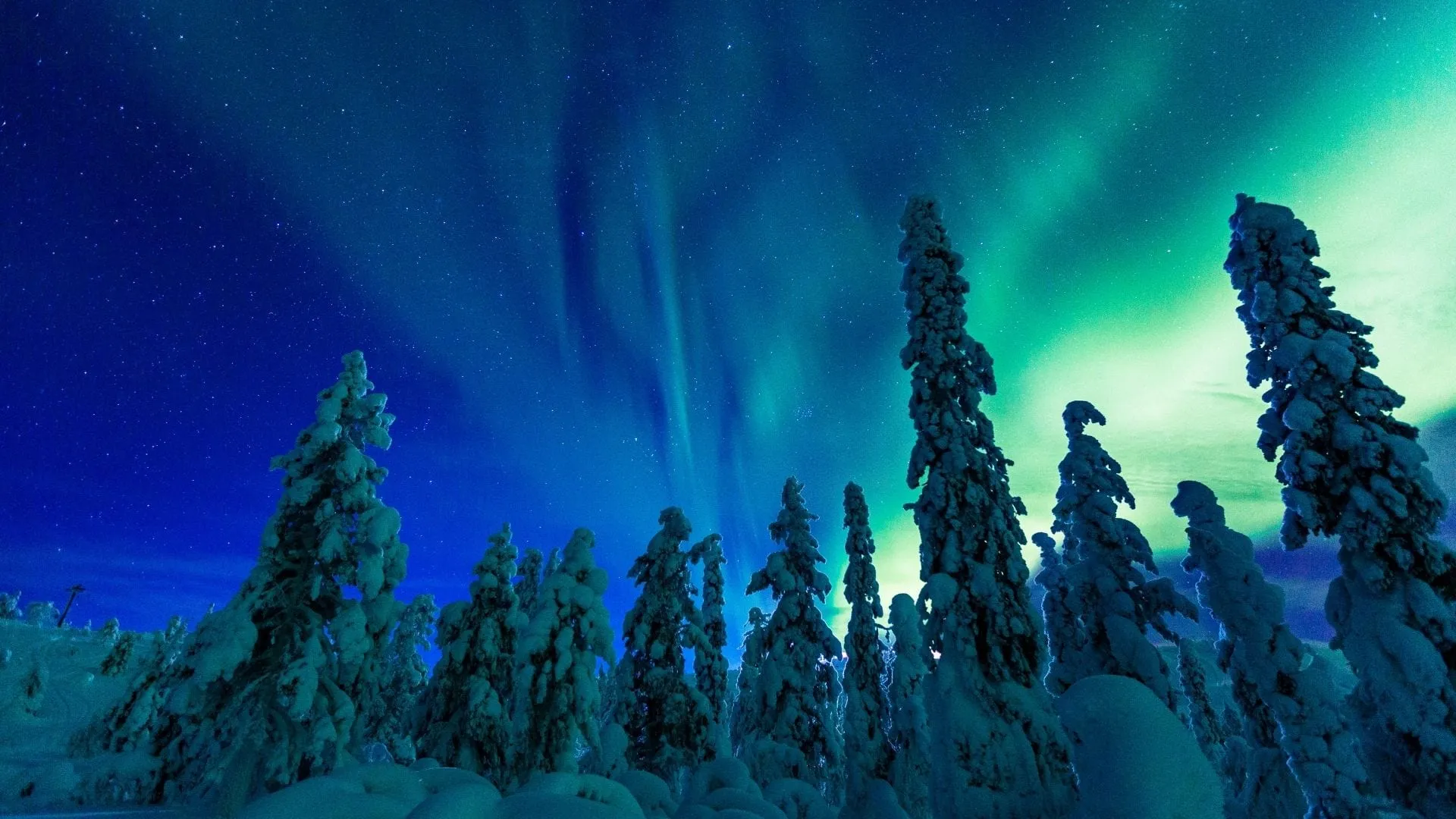
Under the oval, ordinary activity is enough. That is the difference between waiting for a storm and waiting for a gap in the clouds.
Alaska and northern Canada: the best odds on the continent
Fairbanks and Chena, at the edge of the ring
Fairbanks is the only world-class aurora destination with direct flights from the lower 48, and its interior climate is dry and clear far more often than any coastal site. Chena Hot Springs, an hour northeast, is marginally better placed and has the advantage of being somewhere you can physically survive a February night.
Yellowknife and Churchill, the two that beat Tromsø
Yellowknife is more than a degree better placed than Tromsø, with a continental climate and famously clear skies. Churchill is the surprise of this ranking: a town on Hudson Bay at roughly the latitude of Juneau, sitting almost exactly as close to the oval as northern Norway, with a season that opens in mid-July. Both are expensive to reach and cold beyond negotiation.
Utqiagvik and the polar cap
Push far enough north and you leave the ring through the top. Utqiagvik, at 70.1 degrees geomagnetic, is close to that edge on quiet nights, when the aurora can sit to the south rather than overhead. Svalbard, further still, is known mainly for daytime aurora during the polar night, a phenomenon you will not find anywhere else.
Scandinavia and Iceland: what actually separates them
Norway is the easiest arrival: Tromsø has an international airport and a town you can live in between nights of watching. Alta, further inland, is slightly better placed and noticeably drier. The Lofoten islands have the best landscape of the lot and an ocean sky that changes by the hour.
Sweden owes Abisko’s reputation to geography rather than latitude. The site sits in the rain shadow of the Scandinavian mountains, which strip the moisture out of Atlantic weather: locals call it the blue hole, and it clears far more often than the Norwegian coast at the same latitude.
Finland sells Rovaniemi hardest, because that is where the airport and the Santa Claus village are. For aurora it is the weakest of the Nordic options at 63.6 degrees. Saariselkä and Ivalo, 150 miles north, sit at 65.3 degrees, close to a full Kp step better, and over a week that is several extra nights.
Iceland has the best geomagnetic latitude in Europe and pays for it with the weather. The island sits directly in the North Atlantic storm track. Over sixteen years of weather observations, from September to March, about four nights in ten offer at least two hours of clear sky between 10 pm and 2 am, and a week with no clear night at all is rare: 7% of weeks in Reykjavik, 5% in Akureyri. The north does slightly better, with 44% of nights clear against 41%. The month-by-month detail is in the article on the best time to see the northern lights in Iceland.
Clouds decide more than the Sun
This is the part the destination lists leave out, and it is the part that will make or break your trip. Under the oval, the aurora is close to a given. The gap in the clouds is not.
Coastal sites, Tromsø, Lofoten, Reykjavik, are mild and easy to reach and take Atlantic weather systems head-on. Interior sites, Abisko, Saariselkä, Yellowknife, Fairbanks, Churchill, are colder and harder to reach and clear far more often.
If the aurora is the whole point of the trip, go inland. If the landscape matters as much as the sky, the coast defends itself, provided you budget extra nights.
The season does not open on the same day everywhere, and the south opens first
Here is the second thing the lists get backwards. The further north you go, the longer the season feels in midwinter, and the later it opens in summer.
North of the Arctic Circle, summer nights are not dark at all, and you have to wait for the Sun to drop far enough. The higher your latitude, the longer that wait.
| Place | Sky becomes usable |
|---|---|
| Churchill, Manitoba | July 18 |
| Whitehorse, Yukon | July 28 |
| Yellowknife, NWT | August 4 |
| Fairbanks, Alaska | August 13 |
| Abisko, Sweden | August 24 |
| Tromsø, Norway | August 27 |
Six weeks separate Churchill from Tromsø at the opening. The month-by-month detail, with the Moon and the solar cycle, is on the page about the best time to see the northern lights. In late August, when northern Norway is barely starting, Churchill has been watching for nearly six weeks.
The threshold used here is a Sun 10 degrees below the horizon, not the 18 degrees of astronomical night. That is a deliberate choice: a real aurora is visible well before the sky is perfectly black. On the 18-degree threshold Tromsø would not open until September 18, and you would lose three weeks of season that genuinely exist. Norya uses the same 10-degree threshold in its darkness calculation, for the same reason.
Tonight, near me: what the question really means
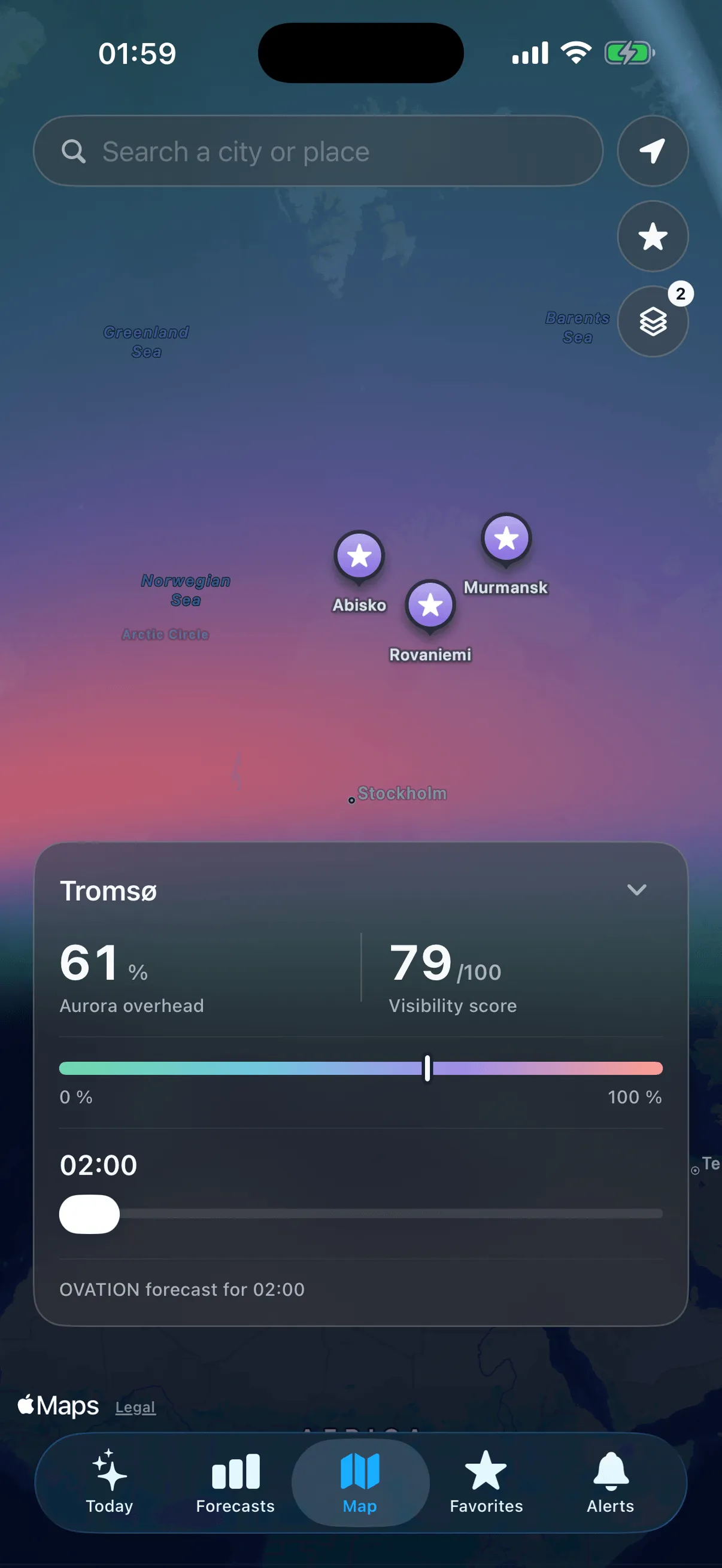
Most searches about the northern lights are not really about geography. They are about tonight, from wherever you already are, and no list of destinations answers that.
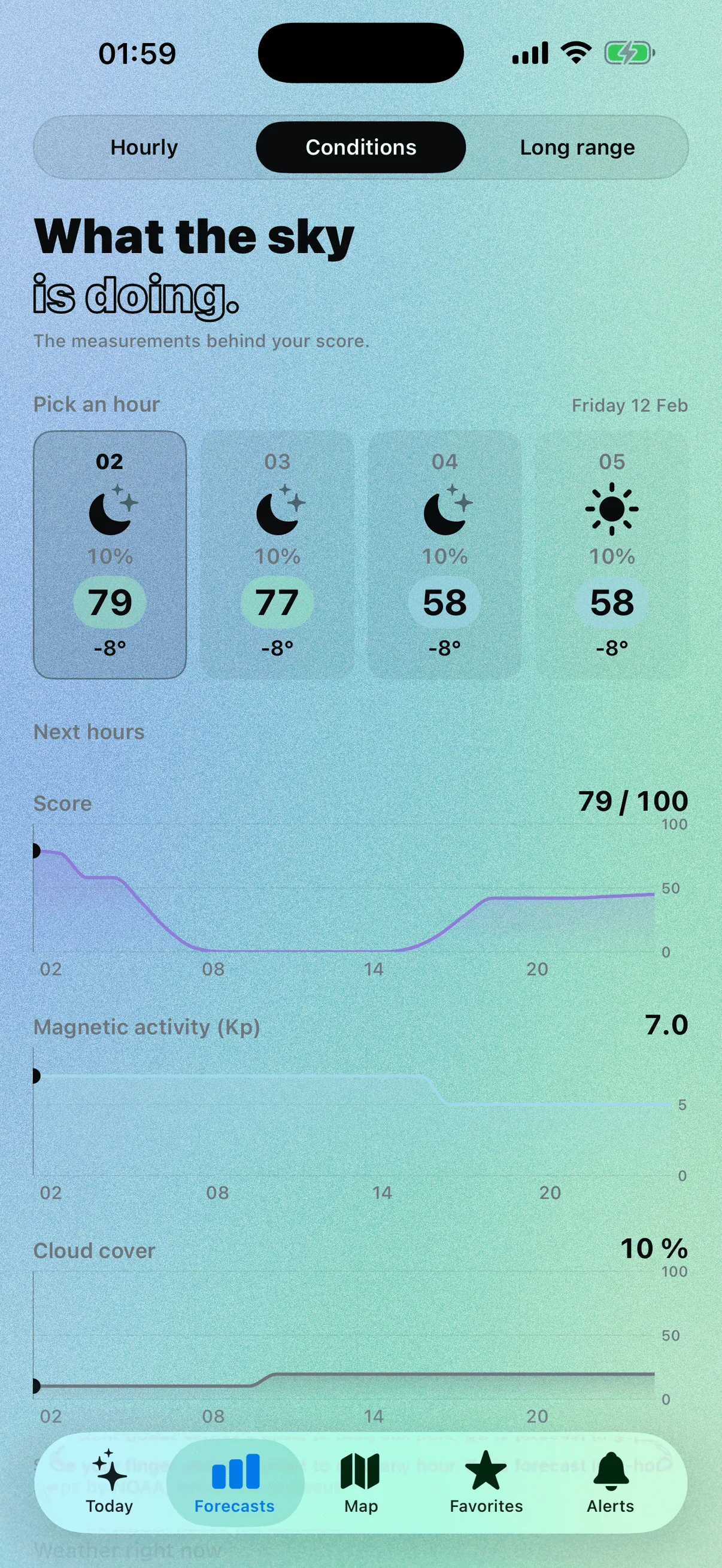
Three things have to line up at once: enough activity for your geomagnetic latitude, a sky clear enough in the right direction, and a Moon that is not washing everything out. Miss one and the night is wasted. A Kp 6 alert is worth nothing under a solid deck of cloud, and this is the single most common reason people stand outside for an hour and see nothing.
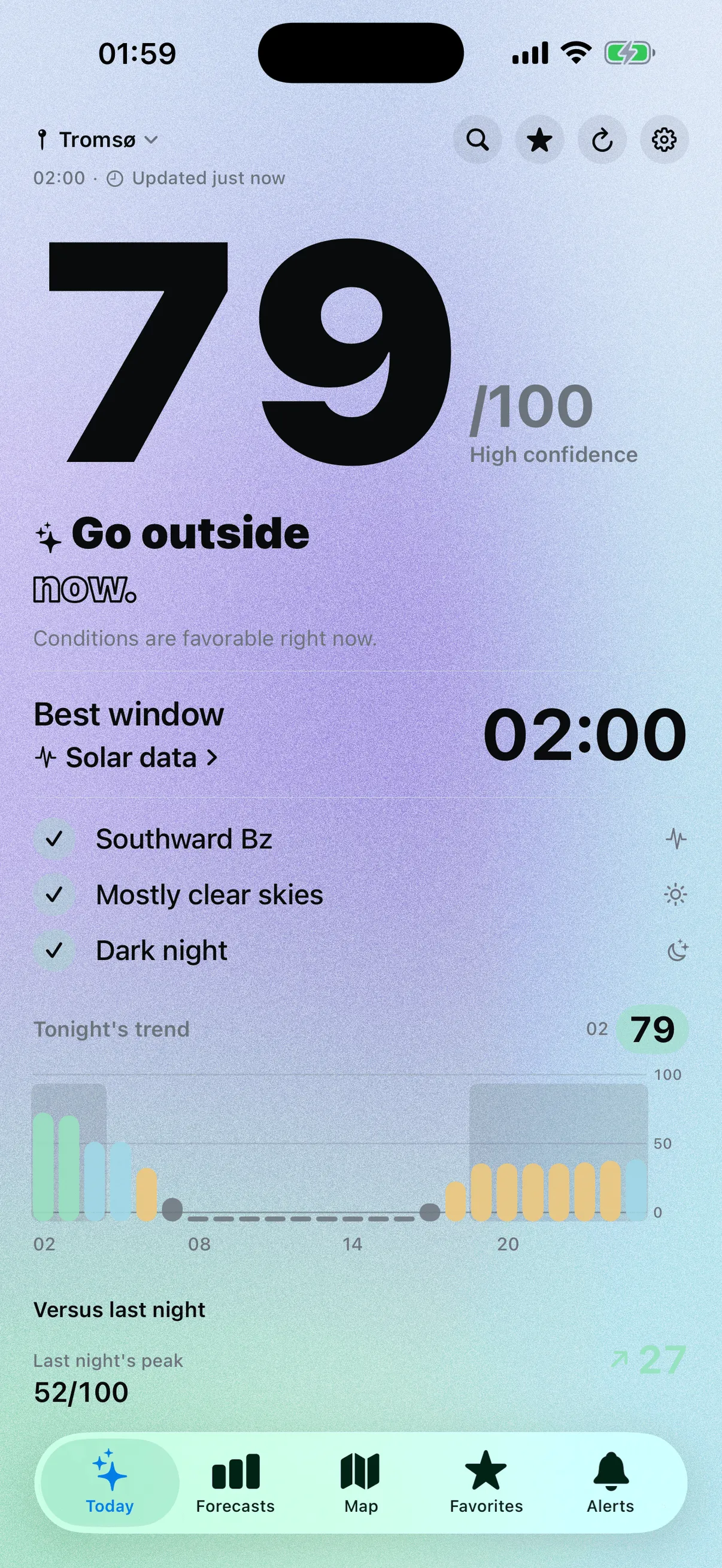
That is the whole point of a score rather than an index: one number for your exact position and the hour ahead, clouds and Moon included, and an honest refusal when a piece of data is missing. For a trip, the 15-day pass at €2.99 covers the length of a stay and stops by itself, with nothing to cancel when you get home.
If you want the full comparison of what the aurora apps actually do with that question, including where Norya does worse than its rivals, it is on the best aurora forecast app page.
On the ground: picking your night and your spot
Get out of the light, even by ten miles. Reykjavik, Tromsø and Fairbanks are all bright enough to erase a faint aurora. Half an hour of driving changes everything, and that is what the guided tours are really selling.
Look for open sky more than a northern horizon. From Minnesota or Scotland you watch the north, because the aurora stays low. Under the oval it is above you, so what counts is how much sky you can see at once.
Watch the Moon. A full Moon does not kill an active aurora, but it erases the weak ones. Over a week-long trip, aiming for the first or last quarter makes a real difference.
Aim for 10 pm to 2 am. The peak sits around magnetic midnight, when your position passes closest to the middle of the geomagnetic night. A storm can of course arrive at any hour of darkness.