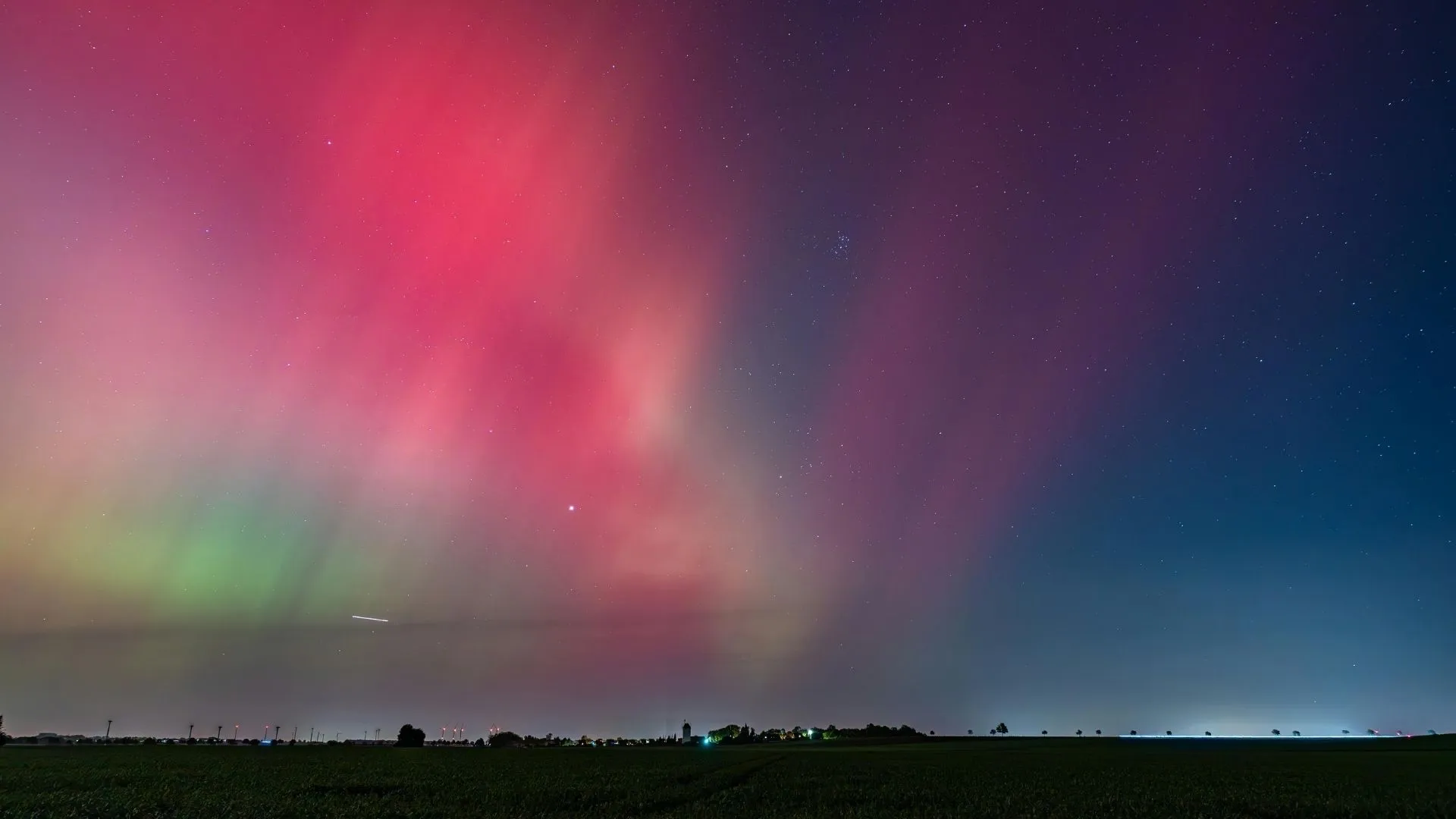
The best time to see the northern lights in Iceland runs from August 10 to May 4 in Reykjavik, not “September to April” as nearly every guide says. September, October, March and April are the most active months, December the quietest. The sky, though, has no good month: four nights in ten offer a clear window, from one end of the season to the other. The measured compromise: October.
Some guides crown March, others sell December for its long nights. Both are partly right, and this page shows how, month by month, with three measurements the guides do not give: the hours of usable night, the share of clear nights over sixteen years of airport weather observations, and the Moon for the 2026-27 season. They are frequencies, not a forecast: no month guarantees an aurora.
In Reykjavik the season runs from August 10 to May 4, not September to April
An aurora needs a dark enough night, and the question is when the sky gets there. Norya uses a Sun more than 10 degrees below the horizon, the point at which a real aurora becomes visible. The usual rule asks for 18 degrees: astronomical night. The two give very different seasons.
| City | −10° threshold | The −18° rule | Gain |
|---|---|---|---|
| Reykjavik | Aug 10 to May 4 (268 days) | Sep 3 to Apr 10 (220 days) | 48 days |
| Akureyri | Aug 15 to Apr 29 (258 days) | Sep 8 to Apr 6 (211 days) | 47 days |
Why every guide says “September to mid-April”
Because they apply the −18° rule, and in Reykjavik it gives exactly that: September 3 to April 10. It is not a mistake, it is a convention inherited from astronomy, which wants a black sky to measure faint stars. An aurora is visible well before that: the opening moves up by more than three weeks and the close moves back by as much. The comparison of this threshold place by place is in the guide on where to see the northern lights.
August and early May: possible, but thin
This is what readers searching “Iceland August” or “Iceland May” want to know. In Reykjavik usable night is 2.7 hours on August 15 and 5.8 hours on the 31st. In Akureyri, in the north, it reaches only 0.3 hours on August 15: the season has barely begun there. At the other end, Reykjavik still has 2.2 hours on May 1, then nothing from the 5th, while in Akureyri usable night has already gone by the end of April.
Calling May “impossible” is true from the 5th, not before. But “possible” means a few hours in the deepest part of the night, under a clear sky. It is not something to build a trip around.
Month by month: August to April, what each one brings
Three measurements describe a month: the hours of usable night, the share of storm days, and the share of nights with a clear sky. The table puts them together, with the Moon’s dark window for 2026-27. It is folded away because it is long: the four parts below give the essentials.
The full table: nine months, six measurements
| Month | Usable night, Reykjavik | Usable night, Akureyri | Storm days | Clear nights, Reykjavik | Clear nights, Akureyri | Moon dark window |
|---|---|---|---|---|---|---|
| August | 2.7 h | 0.3 h | 10.6% | n/a | n/a | past |
| September | 7.8 h | 7.5 h | 14.0% | 42% | 43% | past |
| October | 11.2 h | 11.2 h | 12.5% | 41% | 44% | Oct 5 to 15 |
| November | 14.1 h | 14.2 h | 10.3% | 41% | 42% | Nov 4 to 14 |
| December | 15.6 h | 15.9 h | 4.7% | 45% | 47% | Dec 4 to 14 |
| January | 14.9 h | 15.2 h | 6.2% | 43% | 42% | Jan 2 to 12 |
| February | 12.5 h | 12.6 h | 7.9% | 36% | 47% | Feb 1 to 11 |
| March | 9.6 h | 9.4 h | 11.9% | 39% | 43% | Mar 3 to 13 |
| April | 5.5 h | 5.0 h | 11.8% | n/a | 46% | Apr 1 to 11 |
Usable night: on the 15th of the month, Sun more than 10° below the horizon. Storm days: share of days when the Kp index reaches at least 5, 1996 to 2025 (GFZ Potsdam, CC BY 4.0). Clear nights: share of nights with at least two consecutive hours of sky at most half covered between 10 pm and 2 am, 2010 to 2025. n/a: that window is not often enough in usable darkness. April in Akureyri rests on 65 nights only.
August and September: the opening
The season opens in August, but timidly: 2.7 hours of usable night in Reykjavik on the 15th, 0.3 in Akureyri. September changes everything. On the 15th usable night is 7.8 hours in Reykjavik and 7.5 in Akureyri, and it is the most active month of the year: 14% of days reach Kp 5 or higher, thanks to the equinox effect explained in the guide on the best time to see the northern lights. As for the sky, 42% of nights in Reykjavik and 43% in Akureyri offer a clear window.

Grass, patches of snow and an aurora already: the look of the opening.
October and November: the heart of the season
October is the month of compromise. Usable night reaches 11.2 hours in both cities, storm days stay at 12.5%, the second highest of the year, and 41% of nights in Reykjavik offer a clear window (44% in Akureyri). In 2026 the Moon-free window runs October 5 to 15.
November lengthens the night to 14.1 hours and lowers activity to 10.3% of days. The sky does not change: 41% of nights are clear in Reykjavik, 42% in Akureyri. The Moon-free window runs November 4 to 14.
December and January: the long night, the lowest activity
December gives the longest night of the season, 15.6 hours in Reykjavik and 15.9 in Akureyri, and the lowest activity: 4.7% of storm days, with January barely higher at 6.2%. Some guides sell it as the most likely month because the nights are longest. Both statements hold together: the aurora is most present in December and least intense. Under the oval it is there anyway; what is missing are the storms that make it spectacular.
As for the sky, December is among the months with the most clear nights: 45% in Reykjavik, 47% in Akureyri.

Midwinter: ice, snow, and the aurora above.
February, March and April: the close
February is the only month where north and south clearly diverge: 36% of nights clear in Reykjavik, 47% in Akureyri. Usable night is 12.5 hours, activity 7.9%. March brings activity back to 11.9% for 9.6 hours of night, with 39% of nights clear in Reykjavik and 43% in Akureyri. That is why it is often called the best month: it is among the most active, even though its nights are shorter and its clear share is no better.
In April usable night is only 5.5 hours in Reykjavik on the 15th and 5.0 in Akureyri, for activity that is still high at 11.8%. The season closes on April 29 in Akureyri and May 4 in Reykjavik. For April the clear-night measure exists only for Akureyri (46%, on 65 nights only, to be read as an indication): in Reykjavik the 10 pm to 2 am window is too rarely in usable darkness.
The sky has no good month: four nights in ten offer a clear window
This is the variable guides rarely put a number on, and the one people fear most: what if it is cloudy? It can be measured. The airports of Reykjavik and Akureyri have published weather observations, including cloud cover, for years. We kept the last sixteen, 2010 to 2025, and counted the share of nights that offer at least two consecutive hours of sky at most half covered between 10 pm and 2 am, the window NOAA recommends. Only nights when that window lies entirely in usable darkness are kept, so every month compares on equal terms.
The result is flat. In Reykjavik the share runs from 36% in February to 45% in December: nine points between the best and the worst month. In Akureyri, from 42% to 47%. No month guarantees a clear sky, none rules it out, and choosing September over February changes little on this front.
How many nights to plan: seven nights, three clear windows on average
What changes your odds is the number of nights. The figures below are computed on real runs of consecutive nights, September to March, not by assuming each night is independent of the others: bad weather lasts several days.
| Over a run of | Reykjavik | Akureyri |
|---|---|---|
| 1 night | 41% | 44% |
| 3 nights | 72% | 75% |
| 5 nights | 86% | 88% |
| 7 nights | 93% | 95% |
Share of runs in which at least one night is clear.
Three nights therefore leave about one chance in four of seeing nothing. Seven nights bring that risk down to 7% of weeks in Reykjavik and 5% in Akureyri, with on average three clear nights out of seven. It is the best argument for a week rather than a weekend.
South or north: the north gains a few points, eleven in February
Over the whole season Akureyri has 44% of nights clear against 41% in Reykjavik: three points, not enough to decide an itinerary. February is the exception, with an eleven-point gap. Both cities sit under the auroral oval, at 68.9° and 69.7° geomagnetic latitude, so the aurora passes overhead from Kp 0. Choose north or south by what else you want to see.
What this measurement does not tell you
It rests on one observation point per city, at the airport, and covers only low and mid-level cloud: a clear sky in Reykjavik is not necessarily clear at Þingvellir, and a veil of high cloud can go unnoticed. It says nothing about the strength of the aurora or its position in the sky.
Method and source: METAR observations from Reykjavik (BIRK) and Akureyri (BIAR) airports, 2010 to 2025, via the Iowa Environmental Mesonet, about 140,000 reports per station. CAVOK, NSC, SKC and CLR skies count as clear, FEW and SCT as at most half covered. About a quarter of reports carry no cloud information and are discarded. Iceland keeps UTC time all year.
Storms and the Moon: what the month adds to an aurora that is already there
Under the oval, the aurora passes over your head without any storm being needed. A storm does not create it: it stretches it, makes it brighter and sets its curtains dancing. The storm-day statistic, higher in September, October, March and April, reads as a measure of intensity, not of presence.
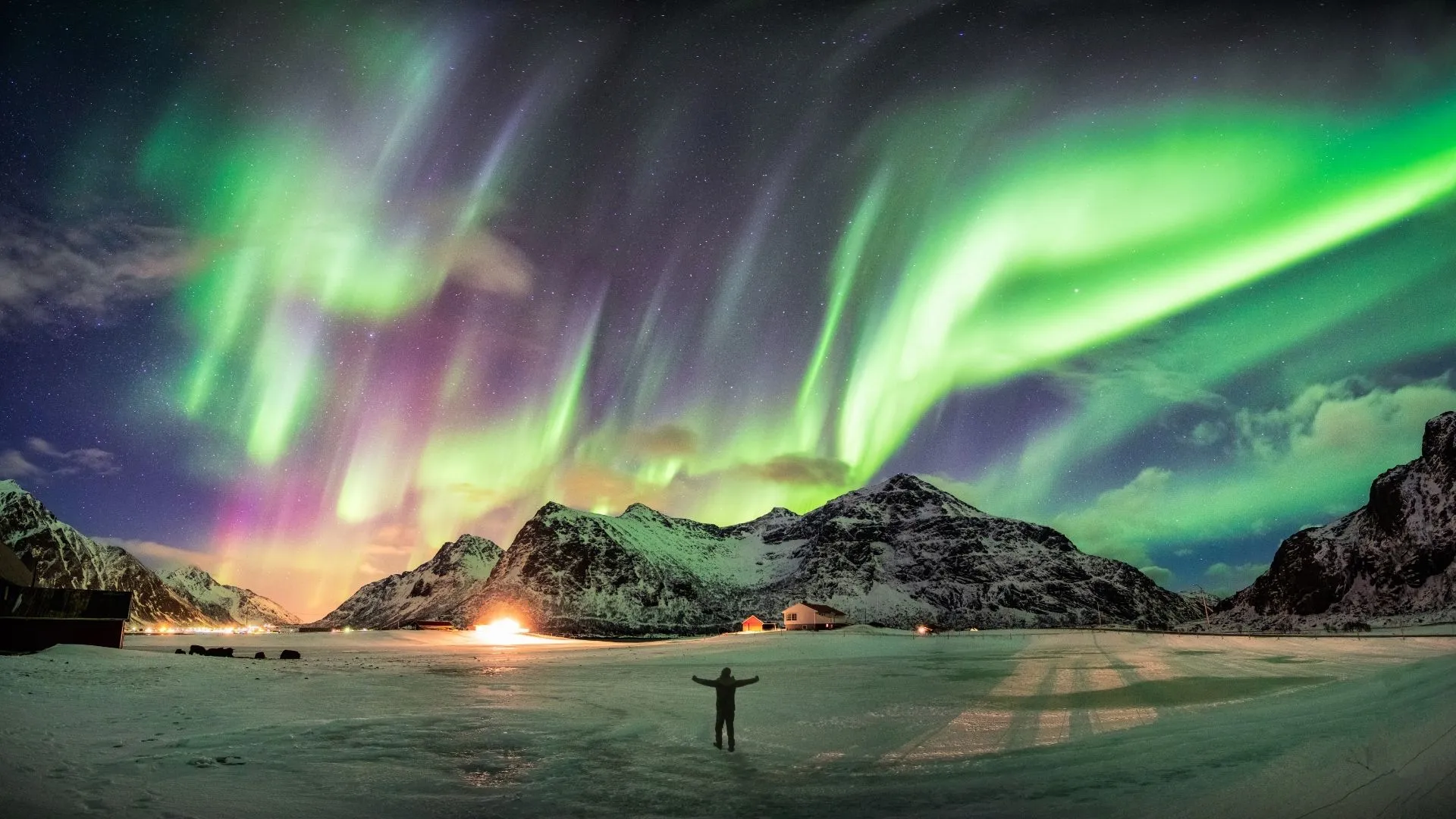
A vivid aurora: what the stormy months add to the ordinary one.
The Moon can be read months ahead. A full Moon does not switch off an active aurora, but it washes out the faint ones. Within five days of the new moon, at most 26% of the disk is lit.
| Month | Dark window | Full moon |
|---|---|---|
| October 2026 | Oct 5 to 15 (new moon Oct 10) | Oct 26 |
| November 2026 | Nov 4 to 14 (new moon Nov 9) | Nov 24 |
| December 2026 | Dec 4 to 14 (new moon Dec 9) | Dec 24 |
| January 2027 | Jan 2 to 12 (new moon Jan 7) | Jan 22 |
| February 2027 | Feb 1 to 11 (new moon Feb 6) | Feb 20 |
| March 2027 | Mar 3 to 13 (new moon Mar 8) | Mar 22 |
| April 2027 | Apr 1 to 11 (new moon Apr 6) | Apr 20 |
Dates in Icelandic time (UTC). Calculated in October 2026 for the 2026-27 season and refreshed every year. Phases come from Meeus’s algorithm, checked against five known dates: the largest error is under one minute.
Norya computes the Moon’s phase and its height above your horizon, along with the cloud cover over you, and folds them into its score: a Moon that has set by 11 pm does not penalize the rest of the night, and an overcast sky lowers the number instead of being ignored.
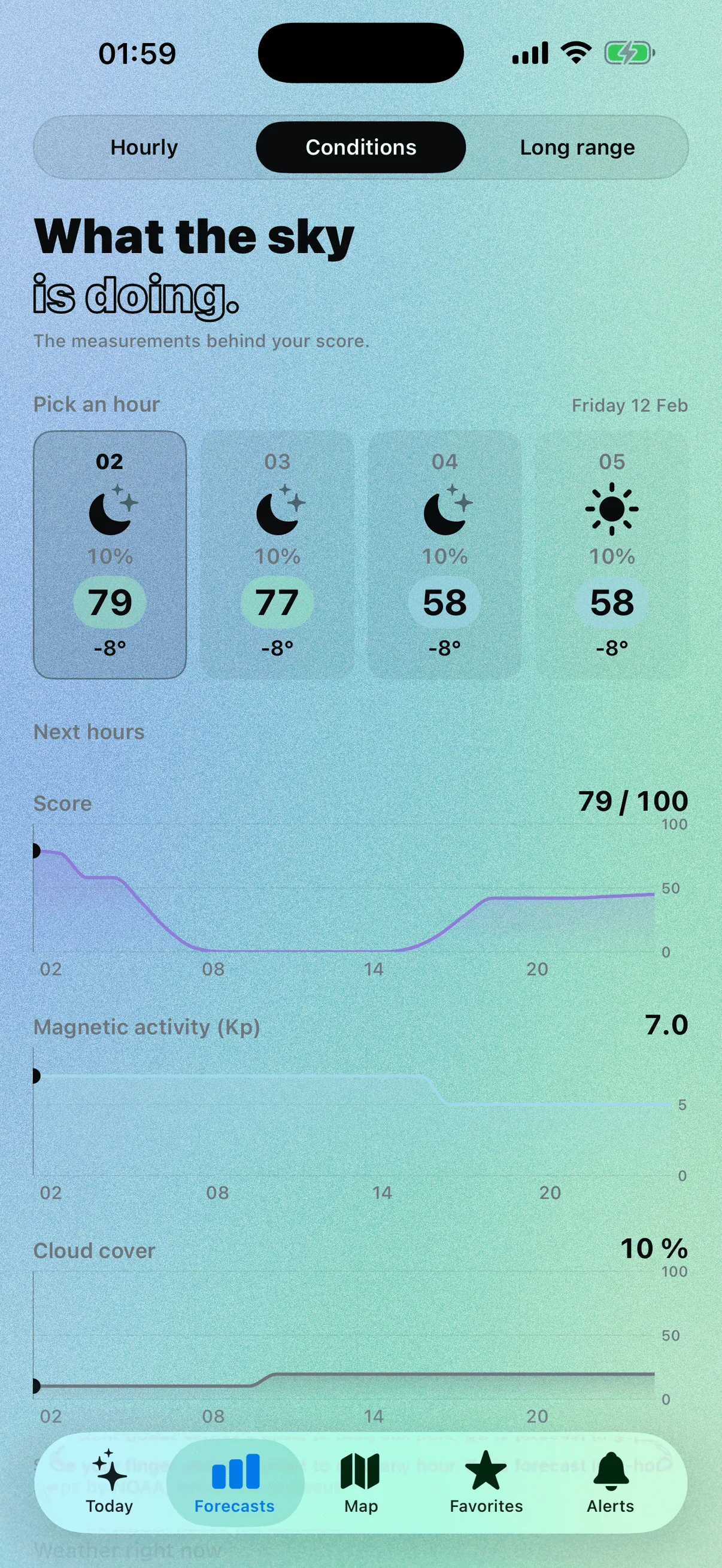
The five factors, Moon and clouds included, for your position.
Where to read the Icelandic forecast, and what it does not replace
The Icelandic Met Office, Veðurstofa Íslands, publishes an aurora forecast with a low and mid-level cloud cover map over six days, and the activity forecast for midnight on a scale of 0 to 9. It is the local reference, and the first thing to open once you are there.
It does not replace two things. First, patience: a six-day cloud forecast is still a forecast. Second, the calculation for your exact position, which combines activity, clouds, true darkness and the Moon into a single number. That is what Norya does, without you having to cross-read four maps.
2026-2027: does the year matter?
Under the oval, very little: the aurora is there whatever the year, unlike the lower 48 or Europe where everything depends on storms. The solar cycle changes the strength, not the presence. If cycle 25 follows the pattern of the previous two, 2026 and 2027 stay rich in storms, as the solar cycle section of the guide on the best time to see the northern lights explains.